Universities & Colleges in Rhode Island
Rhode Island's remarkable academic institutions — from an Ivy League powerhouse to the world's most celebrated art school — have shaped American intellectual and creative life for centuries.
A Small State with an Outsized Academic Legacy
Rhode Island is home to more universities and colleges per square mile than almost any other state in the nation — and the quality of these institutions is extraordinary.
For such a compact state, Rhode Island's contribution to American higher education is strikingly disproportionate. The Ocean State is home to more than a dozen colleges and universities, including one of the eight prestigious Ivy League schools, the most celebrated art and design college in the world, a globally recognised culinary university, and a cluster of respected liberal arts, business, and research institutions that draw students and faculty from across the globe.
The concentration of academic talent in Rhode Island — particularly in Providence, where Brown University, RISD, Johnson & Wales, Providence College, and Rhode Island College all reside — creates an intellectual and creative ecosystem unlike anything found in a metropolitan area of comparable size. This density of higher education has been central to Providence's urban renaissance and to Rhode Island's broader economic and cultural vitality.
For visitors and prospective students alike, Rhode Island's campuses are attractions in their own right. Brown's Van Wickle Gates, RISD's Museum of Art, URI's oceanographic research facilities, and Salve Regina's breathtaking Newport setting all make for compelling destinations that enrich any visit to the Ocean State. This guide explores each of Rhode Island's major institutions in depth, covering their histories, academic strengths, campus life, and what makes each one unique.

12+
Colleges & Universities
80,000+
Students Enrolled
#1
RISD — World's Top Art School
1764
Brown University Founded
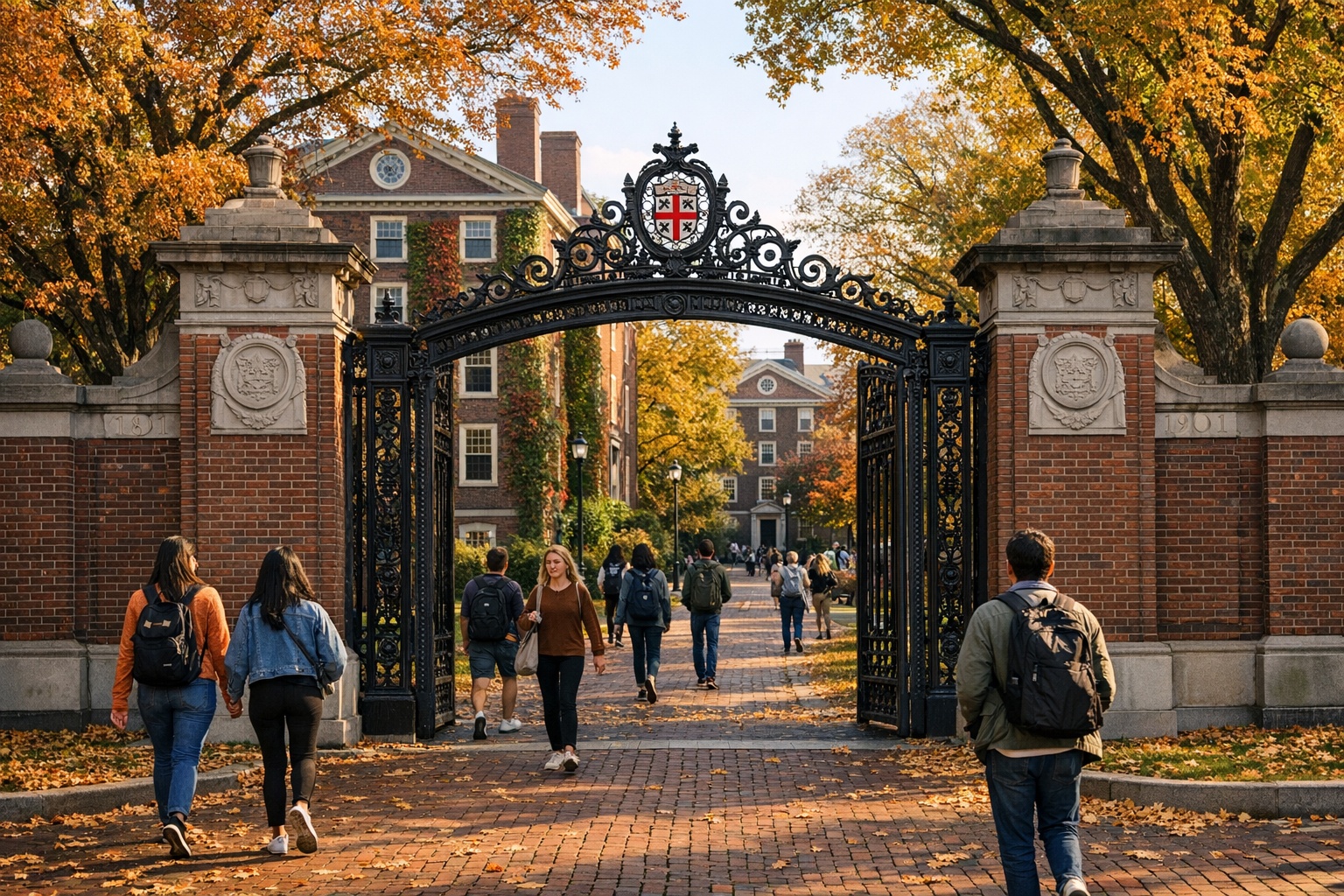

Brown University — Rhode Island's Ivy League Crown
Founded in 1764 as the College of Rhode Island, Brown University is the seventh-oldest institution of higher education in the United States and one of the eight universities that constitute the prestigious Ivy League. Located on College Hill in Providence — a neighbourhood that takes its very name from the hill that Brown shares with the Rhode Island School of Design — the university is one of the most academically distinguished and distinctively liberal institutions in the world.
Brown's campus occupies 146 acres atop College Hill, commanding sweeping views of Providence's downtown skyline and the surrounding New England landscape. The campus's architectural character is defined by a harmonious blend of Georgian colonial and Federal-period brick buildings — many dating from the 18th and 19th centuries — interspersed with carefully chosen modern additions. The John Hay Library, designed in the Beaux-Arts style and completed in 1910, houses Brown's special collections and rare books, including Lincoln manuscripts, Napoleon memorabilia, and Napoleonic-era books. The Rockefeller Library, the John D. Rockefeller Jr. Library, and the Sciences Library form the core of Brown's research facilities.
Academic Culture & the Open Curriculum
What most distinguishes Brown from its Ivy League peers is its Open Curriculum — arguably the most flexible and student-centred undergraduate degree program at any major American research university. Brown has no core curriculum requirements, no distribution requirements, and no mandatory courses of any kind. Students are free to design their own academic programs, taking full advantage of the university's approximately 80 concentrations (Brown's term for majors) or creating their own Independent Concentrations. The only requirement is that students demonstrate proficiency in their chosen field through the completion of an approved course of study.
This radical academic freedom was not always the norm at Brown. The Open Curriculum was adopted in 1969, following a student-led review of the curriculum that produced the "Magaziner-Maxwell Report" — a document that argued passionately for treating students as responsible adults capable of determining their own intellectual paths. The curriculum attracted enormous attention and controversy at the time, but it has since become central to Brown's academic identity and a major draw for the independent-minded students who choose it.
Brown's academic departments are consistently ranked among the national elite. The computer science department — from which several of Silicon Valley's most influential companies have been founded — is particularly strong. The medical school, known as the Warren Alpert Medical School of Brown University, has pioneered the Programme in Liberal Medical Education (PLME), a combined eight-year BA/MD program that admits exceptional high school students directly to the medical school pathway. The School of Public Health addresses global health challenges. The Institute at Brown for Environment and Society (IBES) is a leading centre for climate and environmental research.
Notable Brown Alumni
Brown's alumni network includes some of the most influential figures in American public life, business, and the arts. Among its distinguished graduates: John F. Kennedy Jr. (Class of 1983), who studied history; Emma Watson (Class of 2014), the actress and UN Women Goodwill Ambassador who studied English Literature; Soledad O'Brien, the CNN journalist; John Krasinski of The Office fame; Laura Linney, the Academy Award-nominated actress; Jeff Bewkes, former CEO of Time Warner; and a remarkable cohort of business leaders, Nobel laureates, Pulitzer Prize winners, senators, governors, and ambassadors who have shaped the modern world.
The university's research output is equally distinguished. Brown's Brown Institute for Brain Science brings together neuroscientists, psychologists, engineers, and clinicians in one of the world's leading brain research programmes. The Watson Institute for International and Public Affairs produces policy-relevant research on global governance, development, and security. Brown's Joukowsky Institute for Archaeology and the Ancient World has led major excavations across the Mediterranean and Near East.
Visiting Brown University
The Brown campus is one of the most beautiful in New England and is open to the public. The Van Wickle Gates — the university's ornate wrought-iron ceremonial entrance on Prospect Street — are opened only twice a year: inward during Convocation (when new students arrive) and outward during Commencement. Tradition holds that undergraduates who walk through the gates in either direction before graduation will not complete their degrees, a superstition taken with varying degrees of seriousness depending on the occasion.
The Office of Admission offers guided tours of the campus for prospective students and their families, typically departing from the Waterman Admissions Office on Prospect Street. Self-guided tour maps are also available. The John Hay Library's reading room is open to visitors during regular hours, and the university's public events calendar — lectures, concerts, exhibitions, and sporting events — is extensive and often free to the public.
Rhode Island School of Design (RISD) — The World's Premier Art College
If Brown University represents the pinnacle of liberal arts education, the Rhode Island School of Design — universally known as RISD (pronounced "RIZ-dee") — occupies an equivalent position in the world of art and design. Founded in 1877 by a group of progressive Providence citizens who believed that art and industry needed to collaborate more closely, RISD has grown from a modest drawing school into the most internationally recognised and respected art and design college in the world.
RISD enrolls approximately 2,000 undergraduate and graduate students from all 50 states and more than 60 countries, studying in 19 full-degree programs spanning the fine arts (painting, printmaking, sculpture, ceramics, glass, jewellery and metalsmithing, photography, illustration) and the design disciplines (architecture, graphic design, industrial design, interior architecture, textile design, furniture design, digital media, film/animation/video). The curriculum combines rigorous studio practice with a strong foundation in art history, critical theory, and the liberal arts — a combination that consistently produces graduates who are technically accomplished, intellectually rigorous, and creatively bold.
RISD Museum of Art
RISD's most publicly accessible asset is the RISD Museum, one of the finest art and design museums in the United States. Located in three interconnected buildings on North Main Street at the foot of College Hill, the museum houses more than 100,000 works spanning 5,000 years of human creative history. The collection's breadth is remarkable: ancient Egyptian mummies, ancient Greek and Roman bronzes, Medieval tapestries, European Old Master paintings, Japanese woodblock prints, French Impressionist canvases, American folk art, 20th-century design classics, and cutting-edge contemporary works all find a home here.
The museum is particularly strong in several collecting areas that reflect RISD's own institutional identity. The decorative arts and design collections are among the finest in the world, with holdings spanning furniture, ceramics, glass, metalwork, and textiles from the Renaissance to the present. The textile collection, comprising more than 30,000 objects, is nationally renowned. The Gorham Silver collection tells the story of Providence's most famous industrial legacy — the Gorham Manufacturing Company that produced approximately one-third of all American silverware at its peak in the early 20th century.
RISD's Cultural Impact
RISD's alumni list reads like a who's who of contemporary art, design, and culture. Graduates include Seth MacFarlane (creator of Family Guy), Nicole Krauss (novelist), David Byrne of Talking Heads, Gus Van Sant (film director), Shepard Fairey (creator of the Obama "Hope" poster), Dale Chihuly (the world's most celebrated glass artist), and hundreds of successful working artists, designers, and creative professionals who have shaped the visual culture of our time.
The school's relationships with Providence's broader creative community are deep and mutually enriching. RISD students regularly collaborate with Brown University students through joint courses, clubs, and social events — a natural alliance between two institutions that share not only a hill but a commitment to intellectual curiosity and creative excellence. The RISD Nature Lab, an extraordinary collection of natural specimens used as a resource for observational drawing and design research, is open to students from both schools and reflects RISD's conviction that close observation of the natural world is fundamental to artistic development.
Graduate Programs at RISD
RISD's graduate programs attract students from around the world who seek advanced studio training in a creative environment unmatched elsewhere. Graduate students work closely with faculty who are themselves active practitioners — painters, sculptors, designers, architects, and filmmakers who bring their professional experience directly into the classroom. Graduate students also benefit from RISD's proximity to Boston (just 50 miles) and New York (180 miles), enabling regular engagement with the most important art and design markets in the world.
University of Rhode Island (URI)
The University of Rhode Island is the state's public land-grant research university and its largest academic institution, enrolling approximately 17,000 undergraduate and 4,000 graduate students across its main campus in Kingston and satellite facilities throughout the state. Founded in 1892 as the Rhode Island College of Agriculture and Mechanic Arts, URI has evolved into a comprehensive research university with programmes spanning the liberal arts, sciences, engineering, business, healthcare, and the fine arts.
URI's Kingston campus occupies a beautiful 1,248-acre site in the South County region of Rhode Island, approximately 30 miles south of Providence. The campus's Georgian Revival architecture, set amid mature trees and rolling lawns, creates an idyllic New England collegiate environment. The Upper and Lower Quadrangles, anchored by the historic Davis Hall clock tower, form the iconic heart of campus life and serve as the backdrop for commencement ceremonies each May.
URI's greatest academic strength lies in the ocean and environmental sciences — appropriate for a university located in the Ocean State with direct access to Narragansett Bay and the open Atlantic. The Graduate School of Oceanography (GSO) in Narragansett is one of the most respected oceanographic research programmes in the world, conducting cutting-edge research on topics ranging from ocean chemistry and climate change to fisheries management and deep-sea biology.
The College of Pharmacy at URI is consistently ranked among the top five pharmacy schools in the nation. The College of Engineering houses programmes in civil, electrical, mechanical, and chemical engineering. The College of Business Administration has strong connections to Rhode Island's business community, and the College of Health Sciences includes highly competitive nursing and kinesiology programmes. URI's athletics programme competes in NCAA Division I and is known particularly for its successful men's basketball team, which has produced multiple NBA players over the years.
Other Outstanding Rhode Island Institutions
The Ocean State's academic landscape extends well beyond its most famous names.
Johnson & Wales University
Providence, RI · Founded 1914
One of the world's leading culinary and hospitality universities, JWU's College of Food Innovation and Technology has trained generations of chefs, pastry artists, and food service professionals who now lead kitchens in every great culinary city on earth. The university also offers programs in business, engineering technology, and the arts & sciences.
Enrolment: ~7,500 students · Known for: Culinary Arts, Hospitality Management
Providence College
Providence, RI · Founded 1917
A Catholic liberal arts college operated by the Dominican Friars, Providence College is distinguished by its rigorous Development of Western Civilization program — a two-year interdisciplinary humanities sequence that is the centrepiece of an undergraduate education grounded in the Great Books tradition. PC's Friars compete in the Big East Conference.
Enrolment: ~4,500 students · Known for: Liberal Arts, Business, Men's Basketball
Bryant University
Smithfield, RI · Founded 1863
Bryant University is a nationally recognised business school that has consistently produced top-performing graduates in finance, accounting, management, and entrepreneurship. Its beautiful 435-acre campus in Smithfield is one of the most attractive in New England. Bryant's close connections to the business community ensure strong career placement outcomes for its graduates.
Enrolment: ~3,700 students · Known for: Business, Finance, Entrepreneurship
Roger Williams University
Bristol, RI · Founded 1956
Situated on a 140-acre campus overlooking Mount Hope Bay in Bristol, Roger Williams University (RWU) offers a distinctive blend of practical and liberal education. The School of Law in Providence is one of the most innovative in New England. RWU's architecture programme is highly regarded, and its waterfront location makes the marine biology and environmental science programmes particularly vibrant.
Enrolment: ~5,000 students · Known for: Architecture, Law, Marine Biology
Salve Regina University
Newport, RI · Founded 1934
Salve Regina University occupies one of the most spectacular campus settings in American higher education: a 75-acre oceanfront campus in Newport's historic mansion district, where several former Gilded Age estates — including the magnificent Ochre Court mansion — serve as academic buildings. A Catholic university operated by the Sisters of Mercy, Salve offers strong programmes in health sciences, education, and the humanities.
Enrolment: ~2,700 students · Known for: Ocean campus, Health Sciences, Education
Rhode Island College
Providence, RI · Founded 1854
Rhode Island College is the state's public liberal arts college and the third institution in the Rhode Island Board of Education's public higher education system. RIC serves a diverse population of traditional and non-traditional students with strong programmes in social work, education, nursing, and the arts. The institution has deep roots in the community and plays a vital role in providing accessible higher education across the state.
Enrolment: ~7,000 students · Known for: Education, Social Work, Nursing
Campus Life & Student Culture in Rhode Island
Living in Providence as a Student
Students at Providence's colleges and universities enjoy one of the most rewarding urban living experiences available anywhere in New England. The city is compact, walkable, and safe, with a vibrant social scene centred on Thayer Street (Brown's commercial main street), Federal Hill, the Atwells Avenue restaurant corridor, and the burgeoning Olneyville neighbourhood where young creatives are establishing studios, galleries, and performance spaces in converted industrial buildings.
Providence's arts scene — shaped so profoundly by RISD and Brown — is exceptionally vibrant for a city of its size. Gallery openings, film screenings, experimental performances, and lectures by world-renowned scholars and artists are staples of the calendar, and most are open to the broader community as well as students. The city's restaurants — from the humble and legendary hole-in-the-wall family trattorias of Federal Hill to the nationally acclaimed fine dining establishments on the East Side — make Providence one of the best eating cities in New England.
Academic Collaboration Between Institutions
One of Rhode Island's distinctive academic strengths is the collaboration between its institutions. Brown University and RISD have formalised their historic ties through the Brown|RISD Dual Degree Program, a five-year program leading to both a Brown bachelor's degree and a RISD bachelor of fine arts. Students in the program move fluidly between both campuses, combining rigorous intellectual inquiry with intensive studio practice in a unique educational experience found nowhere else in the world.
Beyond the formal dual degree program, Brown and RISD students regularly take courses at each other's institutions, collaborate on projects, and share cultural and social events. The two schools host joint lecture series, collaborative design projects, and cross-disciplinary research initiatives. This proximity and partnership has created a singularly creative campus culture on College Hill that has produced some of the most innovative minds in contemporary art, technology, and culture.
Johnson & Wales University's culinary students benefit from their proximity to Providence's restaurant scene, which provides an unparalleled living laboratory for the aspiring chef. Many JWU students work part-time or intern at the city's restaurants, farmers' markets, and food businesses, gaining real-world experience that complements their classroom and kitchen training. The school's numerous food events — tastings, competitions, and pop-up dinners — are open to the public and offer a delicious window into the next generation of American culinary talent.
Campus Tours & Visitor Information
Visitors interested in exploring Rhode Island's campuses will find that most institutions welcome the public to their grounds and many offer formal tour programs. Brown University's admissions office on Prospect Street offers scheduled tours and information sessions for prospective students and families. RISD's admissions events include portfolio days, campus tours, and regular visits to the RISD Museum, which is open to the public Tuesday through Sunday. URI's Kingston campus offers guided tours for prospective students departing from the Edward A. Zadzora Welcome Center.
For those with a more independent spirit, a self-guided walk through College Hill encompasses both the Brown and RISD campuses and takes you through some of the most architecturally significant streetscapes in American academic life. From the Van Wickle Gates on Prospect Street, walk south along Waterman and Benefit Streets past colonial mansions and Federal-period houses to RISD's main buildings on South Main and North Main Streets, then continue to the RISD Museum for a world-class art experience without leaving a mile radius.
Rhode Island Universities Comparison
| Institution | Location | Type | Founded | Enrolment | Known For |
|---|---|---|---|---|---|
| Brown University | Providence | Private (Ivy League) | 1764 | ~10,500 | Open Curriculum, Research, Medicine |
| RISD | Providence | Private (Art College) | 1877 | ~2,000 | Art, Design, Architecture |
| University of Rhode Island | Kingston | Public Research | 1892 | ~21,000 | Oceanography, Pharmacy, Engineering |
| Johnson & Wales University | Providence | Private | 1914 | ~7,500 | Culinary Arts, Hospitality |
| Providence College | Providence | Private (Catholic) | 1917 | ~4,500 | Liberal Arts, Western Civilization |
| Bryant University | Smithfield | Private | 1863 | ~3,700 | Business, Finance |
| Roger Williams University | Bristol | Private | 1956 | ~5,000 | Law, Architecture |
| Salve Regina University | Newport | Private (Catholic) | 1934 | ~2,700 | Health Sciences, Oceanfront Campus |
| Rhode Island College | Providence | Public Liberal Arts | 1854 | ~7,000 | Education, Social Work |