Must-See Destinations

Top Attractions in Rhode Island

From opulent Gilded Age mansions and dramatic ocean cliffs to vibrant cultural festivals and pristine Atlantic beaches — Rhode Island's attractions are as diverse as they are unforgettable.

Overview

A World of Wonders in America's Smallest State

Rhode Island's attractions span centuries of history, natural beauty, and cultural achievement — all within a state you can drive across in an hour.

Rhode Island may be the smallest state in the Union, but when it comes to attractions, it is one of the most richly rewarding destinations on the entire Eastern Seaboard. The Ocean State compresses a remarkable diversity of experiences into its compact geography: world-famous Gilded Age mansions in Newport, a thriving cultural and culinary capital in Providence, pristine beaches stretching along the South County coast, the remote, windswept splendour of Block Island, historic lighthouses guarding the bay's entrances, and a network of charming small towns that seem to have stepped straight out of a New England postcard.

What makes Rhode Island particularly special for travellers is its human scale. Unlike larger destinations that require exhausting multi-hour drives between attractions, Rhode Island allows you to experience the ornate grandeur of The Breakers in the morning, walk the Cliff Walk before lunch, and be dining on fresh-caught lobster as the sun sets over Narragansett Bay — all in a single, gloriously packed day. This guide takes you through the state's essential attractions, from the iconic landmarks that draw millions of visitors each year to the hidden treasures that reward the curious traveller.

Newport, RI

Newport — The Jewel of Narragansett Bay

America's first resort city and the playground of the Gilded Age's wealthiest dynasties.

The Breakers Gilded Age mansion Newport Rhode Island with grand stone facade and manicured gardens Newport Rhode Island harbor at sunset with sailboats and colonial waterfront Young woman with dark hair enjoying the WaterFire event in Providence Rhode Island

The Breakers & the Newport Mansions

No attraction in Rhode Island commands more awe and admiration than the magnificent collection of Gilded Age mansions that line Bellevue Avenue and the cliffs overlooking the Atlantic. At the pinnacle of this extraordinary collection stands The Breakers, the 70-room Italian Renaissance palace built for Cornelius Vanderbilt II in 1895. Designed by architect Richard Morris Hunt — the first American to study at the prestigious École des Beaux-Arts in Paris — The Breakers is a monument to wealth and ambition that has no equal in the United States.

The mansion's Great Hall soars 45 feet high, its walls clad in rare Cipollino marble. The Morning Room's gilded bronze panels were created by craftsmen in France and shipped across the Atlantic. The dining room, with its two massive fireplaces and ceiling of painted allegory, could seat 40 guests in splendour that rivalled European royal palaces. Standing on the mansion's ocean-facing loggia, with the Atlantic glittering to the horizon and the salty breeze carrying the scent of the sea, it is impossible not to feel the intoxicating grandeur of the era that produced this extraordinary place.

The Preservation Society of Newport County manages eleven of Newport's historic properties, including Marble House (another Vanderbilt creation, modelled after the Petit Trianon at Versailles), The Elms (a 48-room French neoclassical château), Chateau-sur-Mer (a High Victorian mansion), Rosecliff (the setting for the 1974 film adaptation of The Great Gatsby), and Kingscote (the oldest surviving mansion). Combination tickets allow you to visit multiple properties at a substantial saving, and the society's knowledgeable docents bring the stories of these extraordinary houses vividly to life.

The Cliff Walk — A National Recreation Trail

One of Newport's most beloved experiences costs nothing at all. The Cliff Walk is a 3.5-mile National Recreation Trail that threads along the rugged coastline between the ocean-facing backs of Newport's grandest mansions and the crashing Atlantic surf below. Designated a National Natural Landmark, the trail offers a uniquely democratic experience: ordinary visitors can stroll within feet of the private grounds of the very mansions that once defined exclusive wealth, enjoying views of both architectural splendour and natural beauty simultaneously.

The northern section of the Cliff Walk, from Memorial Boulevard to Narragansett Avenue, is paved and accessible. The southern section becomes progressively wilder and more challenging, with some scrambling required over boulders and rocky outcrops — but the rewards are dramatic. The walk passes Forty Steps, a historic staircase descending to the water's edge where servants and working people once gathered for social events during the Gilded Age. Allow a minimum of two to three hours for the full out-and-back walk, or arrange a taxi or rideshare for a one-way journey.

Newport's Maritime Heritage & America's Cup

Newport's identity has always been inextricably linked to the sea. The city served as the America's Cup host from 1930 to 1983, the longest run in the storied competition's history, and the town's sailing culture remains as vital as ever. The International Tennis Hall of Fame and Museum, housed in the magnificent Newport Casino (the original, not a gambling hall — the word derives from the Italian for "small house"), celebrates another of Newport's aristocratic sporting traditions.

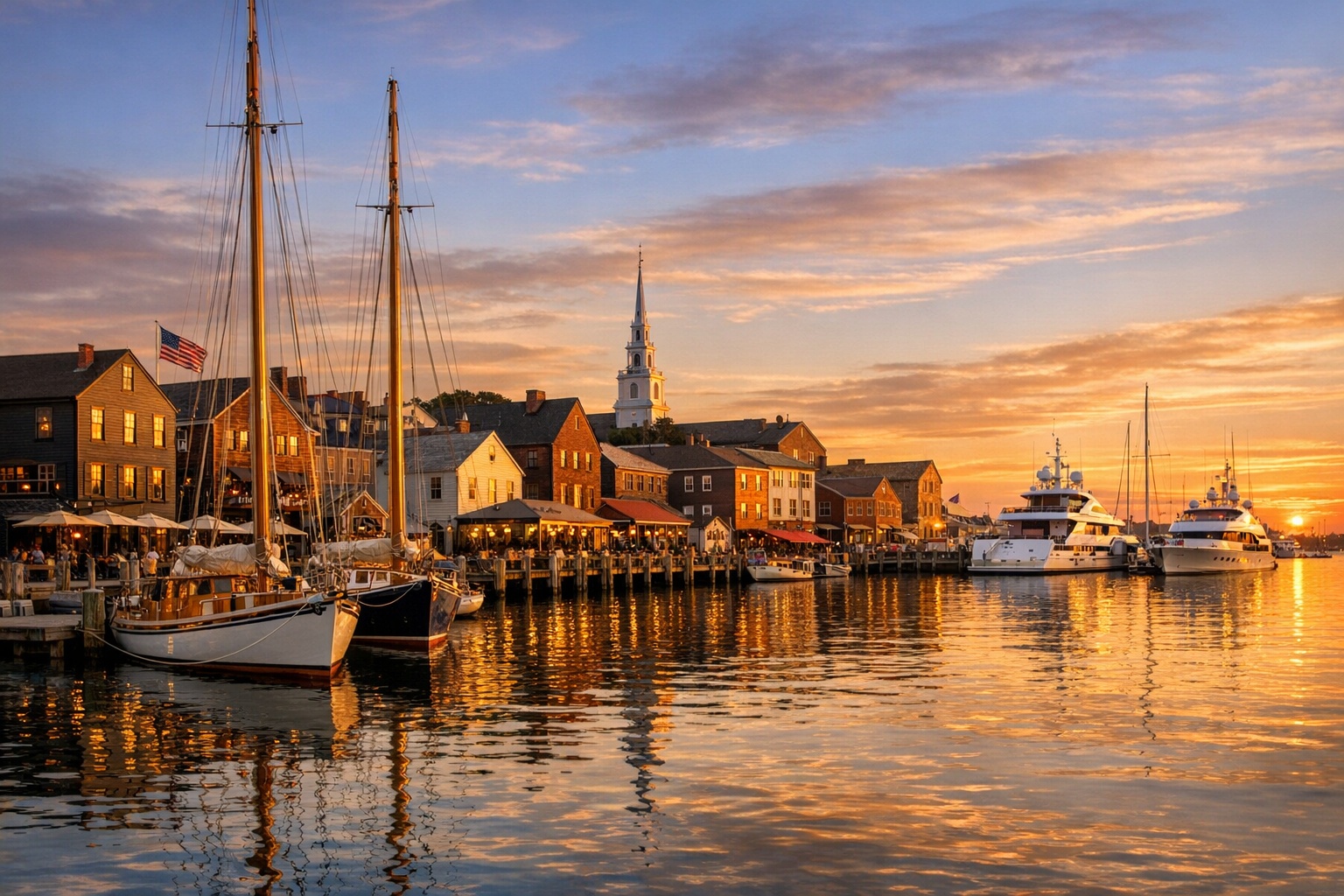
The Newport Harbor, which anchors the city's social life, is best explored on foot along the waterfront boardwalk. Dozens of restaurants, bars, and boutiques line the historic streets, while hundreds of gleaming yachts fill the marina. Thames Street — Newport's main commercial thoroughfare, pronounced "Thaymes" by locals in defiant disregard of English tradition — buzzes with energy from morning coffee to late-night revelry. The Black Pearl, Clarke Cooke House, and Fluke Wine Bar & Kitchen are among the legendary restaurants that have made Newport a culinary destination in its own right.

Touro Synagogue — America's Oldest

Among Newport's many remarkable historic sites, Touro Synagogue holds a unique distinction: built in 1763, it is the oldest surviving synagogue in the United States and a National Historic Site. The Sephardic Jewish community that built it had come to Newport seeking the religious freedom that Roger Williams had made Rhode Island's founding principle. The building, designed by Peter Harrison in the Georgian style, is a masterpiece of colonial architecture, and its connection to George Washington — who sent a famous letter to the congregation in 1790 affirming that the new government gives "bigotry no sanction, to persecution no assistance" — makes it a powerful symbol of American religious liberty.

Providence, RI

Providence — Renaissance City of New England

Rhode Island's capital has reinvented itself as one of America's most dynamic cultural and culinary destinations.

WaterFire Providence

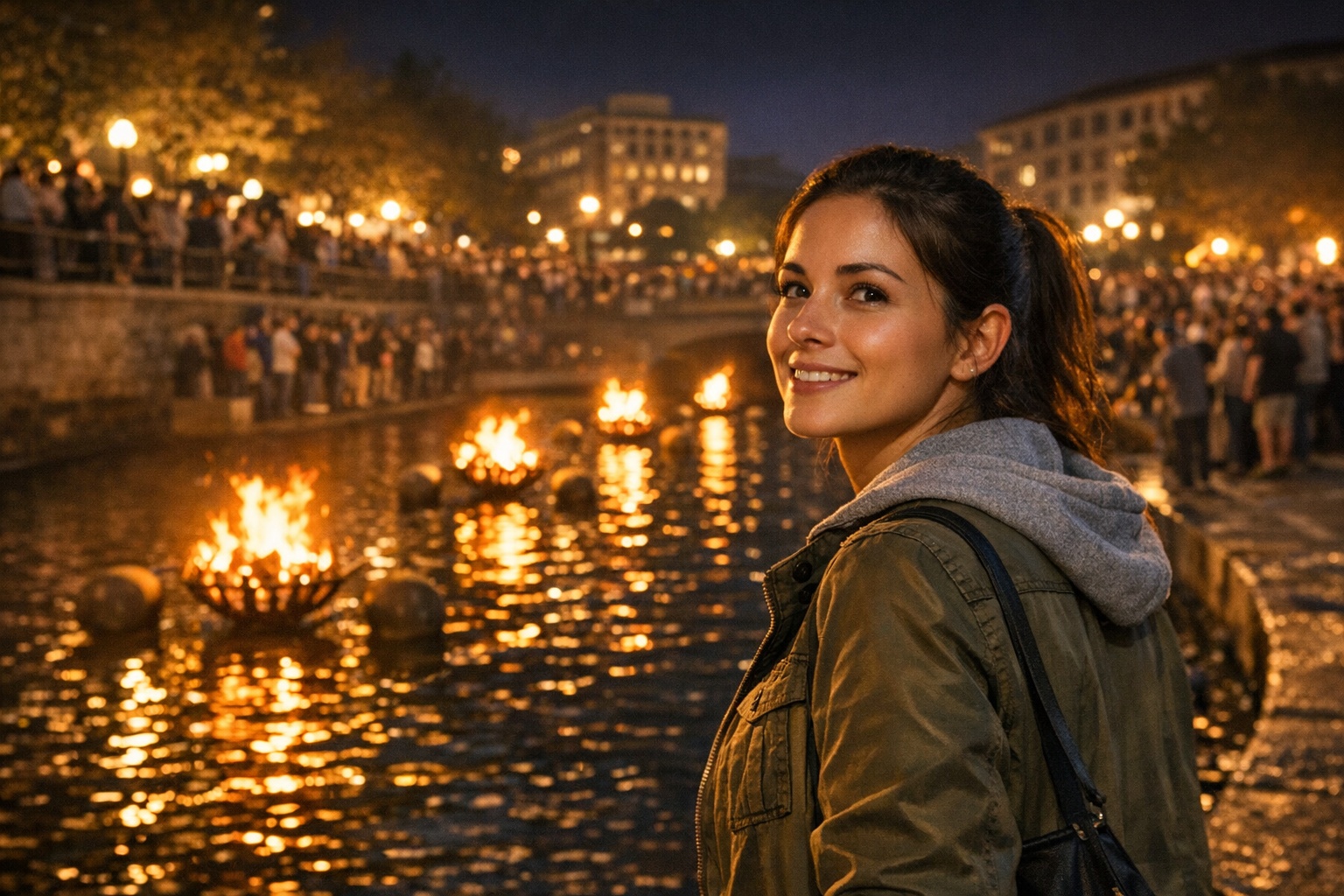
No single event better captures the spirit of modern Providence than WaterFire, the breathtaking art installation created by Barnaby Evans that has become the city's signature cultural event. On selected Saturday evenings from late spring through autumn, nearly 100 iron braziers filled with fragrant cedar and pine logs are set ablaze on the three rivers that converge in the heart of downtown — the Providence, Woonasquatucket, and Moshassuck.

As dusk descends, gondoliers in black cloaks tend the fires from darkened boats, while world music — ranging from Tibetan chanting to Brazilian samba — echoes across the water. Thousands of people line the riverbanks, mesmerised by the dancing flames and their shimmering reflections. The effect is unlike anything else in America: a ritual that is simultaneously ancient and wholly modern, intimate and communal, haunting and joyful.

WaterFire has contributed enormously to Providence's urban renaissance, drawing nearly a million visitors since its inception and transforming the riverbanks from neglected industrial margins into the vibrant heart of the city's public life. The installation has won numerous awards and been featured in media worldwide as one of the most innovative and beautiful public art events on the planet.

Young woman with dark hair at WaterFire Providence with fire braziers reflected on river water

College Hill & Benefit Street

College Hill, the neighbourhood that climbs the hill above downtown Providence on the East Side, is arguably the finest concentration of colonial and early American architecture in the country. Benefit Street — aptly nicknamed the "Mile of History" — is lined with more than 200 meticulously preserved 18th and 19th-century houses in every colonial style: Georgian, Federal, Greek Revival, and Italianate. Walking its length is like strolling through a living architectural museum, with the stories of merchants, sea captains, abolitionists, and founding families written in brick and clapboard on every block.

At the top of College Hill stand Brown University and the Rhode Island School of Design in their shared hillside campus — two of the most influential academic institutions in America, creating a neighbourhood that crackles with intellectual and creative energy year-round. The First Baptist Church in America, founded by Roger Williams in 1638 and housed since 1775 in one of the most beautiful colonial churches in the country, stands nearby as a reminder of the city's founding ideals.

Federal Hill — Providence's Little Italy

Cross the DePasquale Plaza arch on Atwells Avenue and you enter Federal Hill, Providence's beloved Italian-American neighbourhood. The heart of Federal Hill is DePasquale Square, where you'll find the famous bronze pigna (pine cone) — an Italian symbol of abundance and prosperity — hanging above the entrance arch. On warm evenings, the piazza fills with diners spilling out of the trattorias and cafés that line the square, creating an atmosphere that is more Florence than New England.

Federal Hill is home to some of Providence's finest dining, from the legendary Caserta Pizzeria (serving since 1953) to elegant modern Italian restaurants. The neighbourhood's bakeries, cheese shops, salumerias, and espresso bars make it a paradise for food lovers at any time of day. Don't miss Scialo Bros. Bakery, one of the oldest family bakeries in the state, where the smell of freshly baked anise cookies and sfogliatelle is enough to stop you in your tracks.

RISD Museum & Providence Arts Scene

The RISD Museum — the Rhode Island School of Design Museum — is one of the most underrated art museums in the United States. Housing more than 100,000 works of art and design spanning 5,000 years of human creativity, the museum's collection includes ancient Egyptian artefacts, Greek antiquities, French Impressionist paintings, American decorative arts, Japanese woodblock prints, and cutting-edge contemporary works by RISD alumni and faculty. The museum's Gorham Silver Gallery showcases the extraordinary legacy of Providence's Gorham Manufacturing Company, which once produced more than a third of all silverware made in America.

Providence's broader arts scene extends well beyond the museum. The AS220 arts complex — a multidisciplinary arts space occupying several downtown buildings — has been the incubator for generations of Rhode Island artists, musicians, and performers since 1985. The Providence Performing Arts Center, a magnificently restored 1928 movie palace, hosts Broadway touring productions and major concerts. Gallery Night Providence, held on the third Thursday of each month, opens dozens of galleries across the city to the public for free.

Block Island Rhode Island scenic Mohegan Bluffs cliffs overlooking the Atlantic Ocean with wildflowers
Block Island

Block Island — Rhode Island's Unspoiled Island Retreat

Lying 13 miles off the Rhode Island mainland in Block Island Sound, Block Island is one of the most beautiful and ecologically significant places in New England. The island — 7 miles long and 3 miles wide — has been almost entirely preserved from development: the Nature Conservancy designated it one of the "Last Great Places" in the Western Hemisphere, and today roughly 40 percent of its land is permanently protected as wildlife habitat and open space.

The island is approached by ferry from Point Judith (year-round) or from Newport and Providence (seasonal), a crossing that takes approximately an hour and builds the sense of anticipation appropriately. On arrival, the landscape that greets you is one of unspoiled rolling hills, freshwater ponds, stone walls threading through moorland, and the dramatic clay bluffs of the Mohegan Bluffs — 200-foot cliffs that plunge vertiginously to the ocean below, offering some of the most spectacular coastal views on the entire Eastern Seaboard.

The island has no traffic lights and no chain stores. Its compact downtown, centred on Water Street in Old Harbor, is a delightful collection of Victorian hotels, seafood shacks, ice cream parlours, and bike rental shops. Block Island is a paradise for cyclists — a dozen trails and quiet roads wind through the island's varied landscapes — and for birdwatchers: more than 150 species have been recorded during the spring and autumn migrations that concentrate at this pivotal Atlantic Flyway location.

The Southeast Light, a Victorian Gothic lighthouse perched dramatically on the Mohegan Bluffs and listed on the National Register of Historic Places, is Block Island's most iconic landmark. In 1993, in one of the most remarkable engineering feats in lighthouse history, the entire structure was relocated 300 feet inland to prevent it from toppling over the eroding bluffs. Today, visitors can tour the lighthouse and gaze from its gallery over a seascape of extraordinary power and beauty.

How to Get to Block Island
More to Explore

Further Gems Across the Ocean State

Rhode Island's attractions extend far beyond Newport and Providence — here are more essential stops for the curious traveller.

South County

Narragansett Town Beach & the South County Beaches

Rhode Island's South County coastline is home to some of the finest beaches in New England. Narragansett Town Beach, with its iconic stone towers — the only remaining section of the famous 19th-century casino — is the centrepiece of a 3-mile stretch of golden sand that draws surfers, swimmers, and beach lovers from across the region. Scarborough State Beach, Misquamicut State Beach, and East Matunuck State Beach round out a spectacular South County beach circuit.

Pawtucket

Slater Mill — Birthplace of American Industry

In 1793, Samuel Slater opened America's first successful water-powered cotton spinning mill in Pawtucket, launching the American Industrial Revolution. The Old Slater Mill National Historic Landmark complex preserves three historic structures — the Old Mill (1793), the Wilkinson Mill (1810), and the Sylvanus Brown House (c.1758) — where living history demonstrations bring the story of industrialisation to vivid life.

Providence

Roger Williams Park & Zoo

One of the oldest and most beautiful urban parks in America, Roger Williams Park covers 427 acres in the heart of Providence. The park's Victorian-era landscape features winding drives, tranquil ponds, a botanical centre, and the internationally accredited Roger Williams Park Zoo — home to more than 100 species in naturalistic habitats, including African plains animals, snow leopards, and a beloved red panda.

Jamestown

Beavertail Lighthouse & State Park

Beavertail Lighthouse on Conanicut Island (Jamestown) occupies one of the most dramatic headlands in Rhode Island, with ocean views extending in nearly every direction. The lighthouse, first established in 1749, is one of the oldest in America. The surrounding Beavertail State Park offers superb tide pooling, picnicking, and some of the most spectacular ocean scenery in the state.

Newport

Fort Adams State Park

The largest coastal fortification in the United States, Fort Adams dominates the entrance to Newport Harbor on a commanding promontory. The fort, built between 1824 and 1857 and designed to be impregnable by naval attack, can accommodate 2,400 soldiers. Today the 105-acre state park hosts the Newport Folk and Jazz Festivals and offers tours of the fort's labyrinthine tunnels and gun batteries.

Bristol

Blithewold Mansion & Arboretum

Overlooking Narragansett Bay in the elegant town of Bristol, Blithewold is a 33-room English manor house surrounded by 33 acres of breathtaking gardens and an arboretum that includes one of the largest giant sequoias east of the Rocky Mountains. The gardens — featuring rose gardens, woodland walks, water garden, and a cutting garden — are a magnificent four-season attraction.

In Depth

Exploring Rhode Island's Attractions in Detail

The Blackstone River Valley — Cradle of the Industrial Revolution

The Blackstone River Valley National Heritage Corridor stretches 46 miles from Worcester, Massachusetts to Providence, Rhode Island, tracing the course of the river along which the American Industrial Revolution was born. The heritage corridor encompasses dozens of mill villages, factory ruins, historic churches, workers' housing, and landscapes that tell the story of how America transformed from an agrarian to an industrial society in the 19th century.

The corridor's centrepiece is Pawtucket, where Slater Mill stands on the banks of the Blackstone at the waterfalls that provided its power. But the broader corridor rewards exploration: the towns of Woonsocket, Lincoln, Cumberland, and Valley Falls each preserve remarkable industrial-era landscapes, and the Blackstone Valley Bikeway — a developing cycling trail along the river corridor — is slowly making the heritage sites more accessible to non-motorised visitors.

The Museum of Work and Culture in Woonsocket is one of New England's finest social history museums, telling the story of the French-Canadian textile workers who formed the backbone of Rhode Island's industrial workforce. Interactive exhibits, period room reconstructions, and first-person oral histories make the museum an engaging and moving experience for visitors of all ages.

Rhode Island's Lighthouses

With more than 400 miles of tidal shoreline and a history of maritime commerce stretching back to the 1640s, Rhode Island has a rich lighthouse heritage. The state is home to over 20 historic lighthouses, ranging from the grand and still-active Point Judith Light at the entrance to Narragansett Bay to the diminutive Sabin Point Light on the Providence River. The Rhode Island Lighthouse Challenge — an annual event held in October — invites participants to visit as many of the state's accessible lighthouses as possible in a single day.

Castle Hill Light in Newport, perched on a pink granite ledge at the entrance to Narragansett Bay, is perhaps Rhode Island's most photogenic lighthouse. The view from the adjacent Ocean Drive — a 10-mile scenic highway around Newport's southern tip — encompasses the lighthouse, Fort Adams, and the sweeping panorama of the bay and open ocean beyond. Rose Island Light, accessible by boat and operated as an educational lighthouse museum with overnight accommodation, offers one of the most unique experiences in the state.

Rhode Island's Festivals & Events Calendar

Rhode Island's events calendar is packed year-round with festivals and events that celebrate the state's cultural diversity and creative vitality. The Newport Folk Festival in late July and Newport Jazz Festival in early August are internationally famous, selling out months in advance. WaterFire Providence events are held on approximately a dozen Saturday evenings each year, and the schedule is announced on the WaterFire website.

The Providence Restaurant Weeks held in January and August offer remarkable value dining deals at the city's finest restaurants, while the annual Providence Fringe Festival showcases experimental theatre, performance art, and new creative work. The Block Island Race Week in June is one of the premier offshore sailing regattas on the East Coast, drawing competitors from across the country. The Rhode Island Seafood Festival in Providence and the International Quahog Festival in North Kingstown celebrate the state's beloved bivalves with cooking competitions, tastings, and live entertainment.

Shopping & Arts in Rhode Island

Shopping in Rhode Island means independently owned boutiques, artisan studios, and farmers' markets rather than the chain-dominated shopping malls found elsewhere. Providence's Westminster Street — rebranded as "Downcity" — has become a thriving destination for independent fashion boutiques, record shops, and design studios. The Dean Hotel complex on Dorrance Street houses a collection of unique shops and creative businesses alongside one of Providence's most stylish boutique hotels.

Newport's Bellevue Avenue and Spring Street are lined with antique shops, gallery spaces, and boutiques specialising in nautical art, jewellery, and home décor. The Bowen's Wharf waterfront complex combines shopping with harbourside dining and is particularly magical at Christmas, when the town's decorations and the Newport Mansions' Christmas exhibition draw visitors throughout December.

Visitor Tips

Practical Tips for Visiting Rhode Island's Attractions

🎟️ Newport Mansions

  • Buy combination tickets for significant savings
  • Book in advance on peak summer weekends
  • Start at The Breakers — allow 90 minutes minimum
  • The Cliff Walk is free and can be combined with mansion visits
  • Christmas at the Mansions (November–January) is spectacular

🏝️ Block Island Essentials

  • Ferry from Point Judith runs year-round (approx. 55 min)
  • Cars are unnecessary — rent a bike or moped on-island
  • Book accommodation months ahead for summer visits
  • Visit the Mohegan Bluffs for the most dramatic views
  • Excellent snorkelling and paddleboarding in Great Salt Pond

🔥 WaterFire Providence

  • Check waterfire.org for the annual schedule
  • Events are free; arrive early for the best viewing spots
  • Dress in layers — riverfront evenings can be cool
  • Combine with Federal Hill dinner for a perfect evening
  • Photography is spectacular — bring a tripod for night shots

🌊 Beach Season

  • Ocean swimming is best July–September (64–72°F water)
  • Narragansett and Scarborough charge daily parking fees
  • Block Island's beaches are the least crowded and most pristine
  • Surfers favour Narragansett's "The Point" break
  • Watch for rip currents — swim between the flags